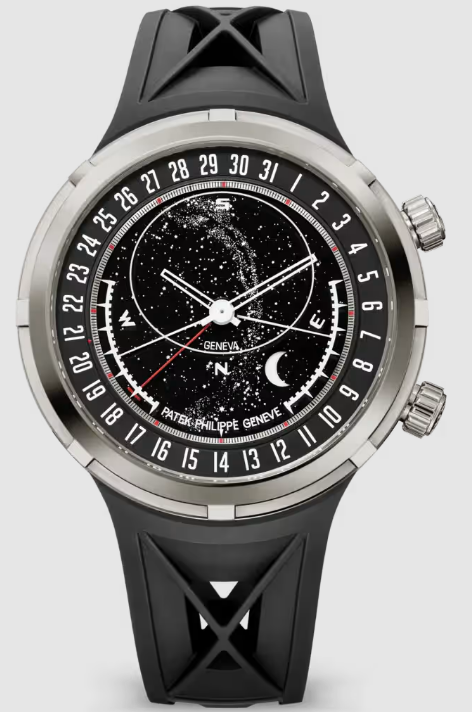
Patek Philippe’s New Skyline Watch Makes a Stunning Debut
The watch boasts a completely redesigned look and cleverly incorporates sunrise and sunset indicators.
This is the third update to Patek Philippe’s Skyline collection. Following the addition of a pointer date display in 2012, this generation adds sunrise and sunset time indicators and features a bold new design, creating a powerful, space-age-inspired 47mm lugless case.
It also introduces a new method for calculating the transition between daylight saving time and standard time, addressing a major shortcoming in astronomical watches for European and American users.
I’ve always believed that Patek Philippe’s greatest strength, besides its massive industrial investment, lies in its exceptional design diversity. Today, many brands seem to strive for a unified design language across all their watches. While this creates a distinctive visual identity, it’s extremely limiting.
Patek Philippe cheap, however, doesn’t face such limitations. Its current collection features around twenty different case designs, and its past collections have included hundreds. While this has led to some design mishaps (at least in my opinion), it has also resulted in some truly stunning creations. I’m sure many will disagree, but I believe the new Celestial watch falls into the latter category.
Patek Philippe’s introduction of a watch with sunrise and sunset displays is belated, and this timepiece further adds the function of automatically adjusting sunrise and sunset times for daylight saving time. This addresses the biggest flaw of this complication, but since its preset time is for the Geneva time zone, this function is largely meaningless for users living at significantly different latitudes, and the astrolabe suffers from the same drawback.
Historically, astronomical watches have been incredibly meaningful to their wearers; for example, the watches of James Ward Packard and Henry Graves II were programmed according to their primary place of residence. Audemars Piguet’s now-discontinued Equation of Time watch proves that even major brands can produce similar watches and add markings, such as changing the sunrise and sunset display areas and the Equation of Time scale ring, to suit the wearer’s city.
The Celestial collection traces its origins back to the significant Caliber 2000, a massive double-sided chronometer watch with extremely high production and retail prices. Patek Philippe subsequently introduced the more affordable Celestial Moon Phase Tourbillon, which incorporated a miniature version of the celestial disc from the Caliber 2000 on the back of the Caliber 5016 movement, with some minor adjustments. https://www.chronowrist.ru
Later, the more accessible Celestial Ref. 5102 was introduced, transplanting the celestial disc function to the Cal. 240 movement, and was upgraded in 2012 to add a date display. Now, Patek Philippe has added a third complication. The complete list of complications is as follows: celestial disc, moon phase and moon phase, sunrise and sunset date and time.
It is not an annual or perpetual calendar, so at the end of months with fewer than 31 days, the date must be manually adjusted using the buttons on the side of the case. This is similar to the Krayon Anywhere, which also uses a simple calendar to drive the sunrise and sunset times display. Cleverly, the pointer-style date ring also serves as the dial for the sunrise and sunset hands.
Pressing the button at 9 o’clock adjusts the displayed time forward by one hour to enter daylight saving time; pressing the single knob at 10 o’clock adjusts it backward by one hour to enter standard time. Finally, the second crown can be rotated in one direction to adjust the astrolabe and in the other to adjust the moon phase. Once set, the moon phase takes over a thousand years to accumulate a one-day error. replica watches
Space Case Patek Philippe describes this case as a “strikingly modern design,” which perhaps doesn’t fully capture its ingenuity. The case, crafted from white gold, measures 47mm in diameter. While not small, its legless design makes it more comfortable to wear than its actual size. The recurring “X” pattern on the sides of the case and strap is inspired by the tubular truss structures commonly found on spacecraft and satellites.
Although Patek Philippe introduced a larger micro-rotor movement several years ago and has used it for a perpetual calendar and some travel time complications, they still rely on the 49-year-old Caliber 240 as its base. This 27.5mm movement is already too small for the 44mm Caliber 6102, and for this 47mm case, a transparent case back would look rather comical, especially considering the top module is almost twice the size of the base. While this size discrepancy is regrettable, thankfully Patek Philippe only offers watches with closed case backs.
When the Caliber 240 was less well-known, it was an excellent and practical movement, capable of providing sufficient torque for its large module while maintaining good timekeeping, and keeping the watch remarkably thin at only 12.29mm.
Patek Philippe Celestial Sunrise & Sunset Watch
Ref. 6159G-001
Diameter: 47 mm
Height: 12.39 mm
Material: 18K White Gold
Crystal: Sapphire Crystal
Water Resistance: 30 meters
Movement: Cal. 240 C LU CL LCSO
Functions: Hours, Minutes, Date, Astronomical Disc, Sunrise & Sunset Times, Date
Frequency: 28,800 vibrations per hour (4 Hz)
Winding: Automatic
Power Reserve: 45 hours
Strap: Rubber with three-piece buckle